

Will AI Recommend Your Product?
The data and trust signals AI needs to drive purchase decisions

Will AI Recommend Your Product?
In traditional ecommerce, brands optimized for search rankings, marketplace placement, paid ads, and product detail pages. The shopper usually entered a keyword, scanned a list of options, opened a few tabs, compared reviews, and made a decision.
AI shopping assistants collapse much of that journey into a conversation. A shopper might ask, “What moisturizer should I buy if I have sensitive skin and live somewhere dry?” The assistant is not just matching keywords. It is interpreting needs, evaluating tradeoffs, and deciding which products deserve to be surfaced. That creates a new challenge for brands and retailers: being available online is no longer enough. Your product needs to be understandable, trustworthy, comparable, and easy to buy. In other words, your product needs to be ready for AI-led shopping.
AI shopping is also changing quickly. The way assistants evaluate products, access data, and influence purchase decisions will continue to evolve as platforms update their models and shopping experiences. This article should be read as a current framework for product readiness, not a fixed rulebook.
When AI is choosing between your product and a competitor’s, what reasons does it need to pick yours? One way to think about it is through a simple AI shopping scorecard:
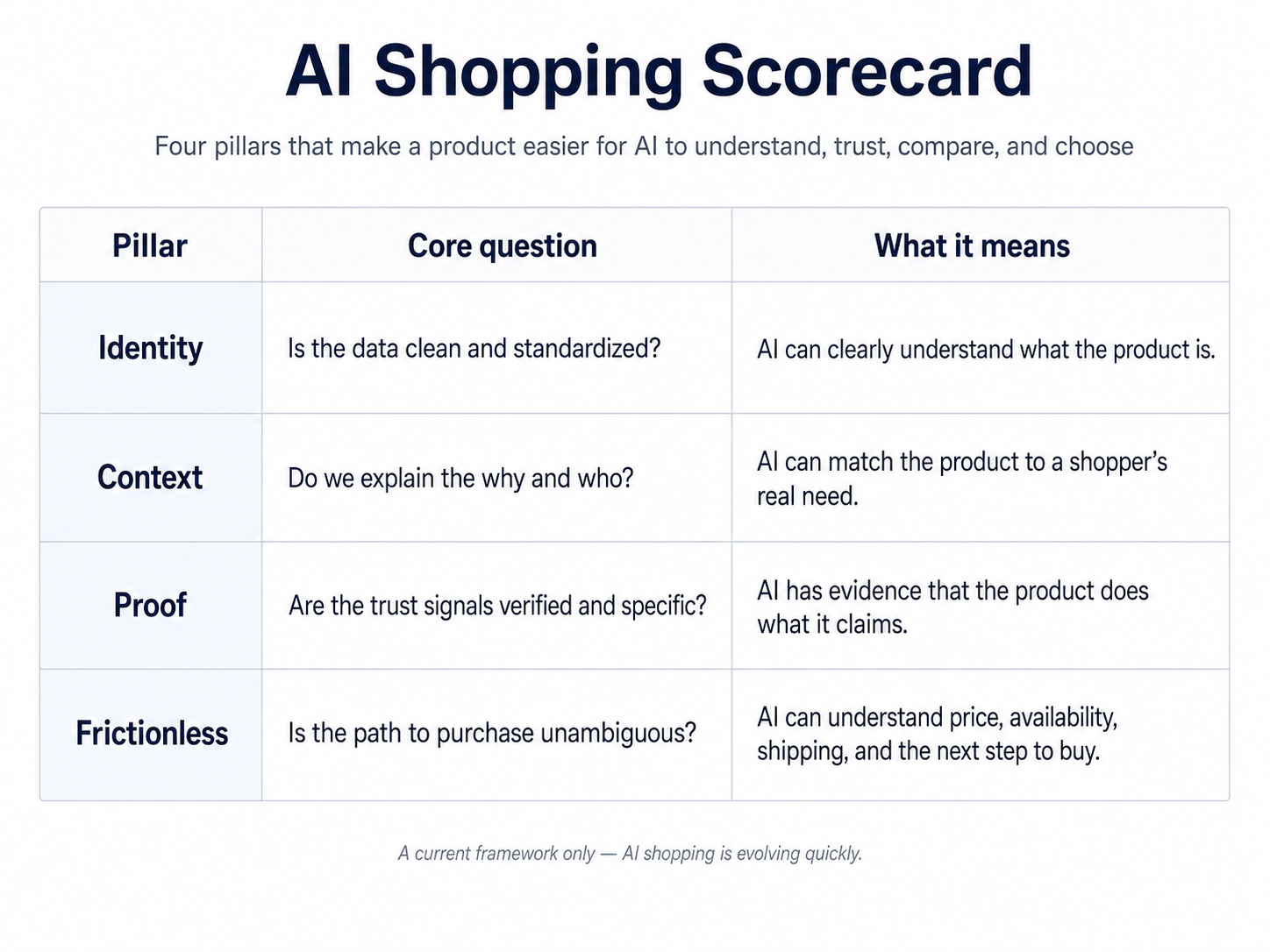
These four pillars help explain what makes a product easier for AI to understand, compare, and choose.
Identity: Clean product data is the foundation
Before AI can compare, trust, or explain a product, it first needs to understand what the product is. That starts with clean product data.
AI shopping assistants depend on product data to identify a product and compare it with alternatives. If that data is messy, incomplete, inconsistent, or vague, the assistant has less confidence in the result. This can happen in simple ways. A product title may differ across retailers. Dimensions may be missing. Materials may be described with marketing language instead of specific details. Compatibility information may be incomplete. Variants may be confusing. One retailer may list a product as a different model than another.
For a human shopper, these issues are annoying. For an AI shopping assistant, they are signals of uncertainty. The assistant needs to know exactly what the product is, what attributes it has, and whether the information is reliable. Clean, standardized data gives the product a clear identity.
Once the product is clearly understood, the next question is whether AI can connect those details to a shopper’s actual need.
Context: Turn product features into shopper reasons
Many product pages describe what a product has. AI shopping assistants also need to understand what those details mean for the shopper. A feature says, “lightweight, water-resistant material” and a shopper reason says, “good for commuting in light rain or weekend trips”. That difference matters because the extra context makes it easier for AI to match the product to a shopper’s actual needs. Most shoppers do not only ask for products by type. They ask based on constraints. They want shoes for wide feet, a sofa for a small apartment, or a laptop for video editing. To answer those questions well, AI shopping assistants need both detailed attributes and clear use-case context.
Merchants can add this context directly to product pages by including sections like “Best for,” “Good for,” “Not ideal for,” or “Common use cases.” For example, an electronics retailer might clarify that a laptop is best for students, video editing, gaming, or everyday work. The goal is not to overclaim. It is to connect product details to real shopper scenarios. Complete attributes help AI understand the product. Use-case context helps AI explain why it is the right choice.
Proof: Trust signals need to go beyond star ratings
Reviews are one of the strongest signals AI shopping assistants can use, but volume alone is not enough. AI needs to know whether feedback is credible, specific, recent, and useful. A product with thousands of vague five-star reviews may be less helpful than one with fewer reviews that clearly explain how it performs in real life.
Merchants can support this by encouraging verified buyers to share specific feedback around quality, fit, performance, durability, pros and cons, and real use cases. Photos, videos, and even critical reviews also help AI understand the full picture, including who the product is right for and what tradeoffs shoppers should consider.
For products where AI shopping assistants need extra confidence, customer reviews alone may not be enough. Expert reviews, certifications, lab tests, awards, buying guides, and third-party benchmarks can help validate product claims. For example, a baby car seat should not be assessed only by star ratings. Safety certifications, crash-test results, expert reviews, and installation guidance all give AI stronger evidence to understand whether the product is reliable and worth considering. Together, customer feedback and expert validation give AI stronger evidence to explain why a product is a good match.
Frictionless: AI evaluates the full buying experience
AI shopping assistants do not just compare products. They compare the full buying experience around those products. Price matters, but so do shipping, returns, bundles, warranties, fulfillment, and availability. If two products are similar, AI needs to understand which option gives the shopper the clearest and strongest path to purchase. That does not always mean the lowest price wins. A merchant may still be the better choice if the product comes with faster shipping, easier returns, a better bundle, a longer warranty, loyalty perks, or more reliable fulfillment. But if a competitor offers the same or similar product with better overall value, AI has less reason to point the shopper toward the weaker option.
Availability is also part of that value. If a product is out of stock, unavailable in the right size or color, or only available with a long delivery window, AI may choose a similar product that is easier to buy. For example, it is not enough to show that a jacket is “in stock” if only one size is available. AI needs to understand which sizes, colors, models, or bundles are actually available so it can match the shopper to an option they can purchase.
Merchants can make an impact by keeping discounts accurate, avoiding misleading sale labels, making shipping and return costs clear, and maintaining accurate inventory at the variant level. Competitive pricing matters, but so does making the total offer easy to understand and easy to act on.
In AI shopping, a product cannot win on product quality alone. It also needs a buying experience that is clear, competitive, and immediately actionable.
The new ecommerce question: will AI choose your product?
As AI shopping assistants become a bigger part of the buying journey, brands and retailers need to rethink what ecommerce readiness means. Visibility is no longer enough. A product also needs the right signals for AI to understand what it is, who it is for, why it is credible, and how easily a shopper can buy it. That readiness can be measured across four pillars: Identity, Context, Proof, and Frictionless. Together, they help answer a simple question: when AI is comparing your product with a similar option, does it have enough reason to choose yours?
The products that win in AI-assisted shopping will not simply be the loudest or most advertised. They will be the ones AI can evaluate with confidence and explain clearly to shoppers. If your product is easy to understand, easy to trust, and easy to buy, it becomes easier for AI to choose. That is the next layer of ecommerce visibility.