
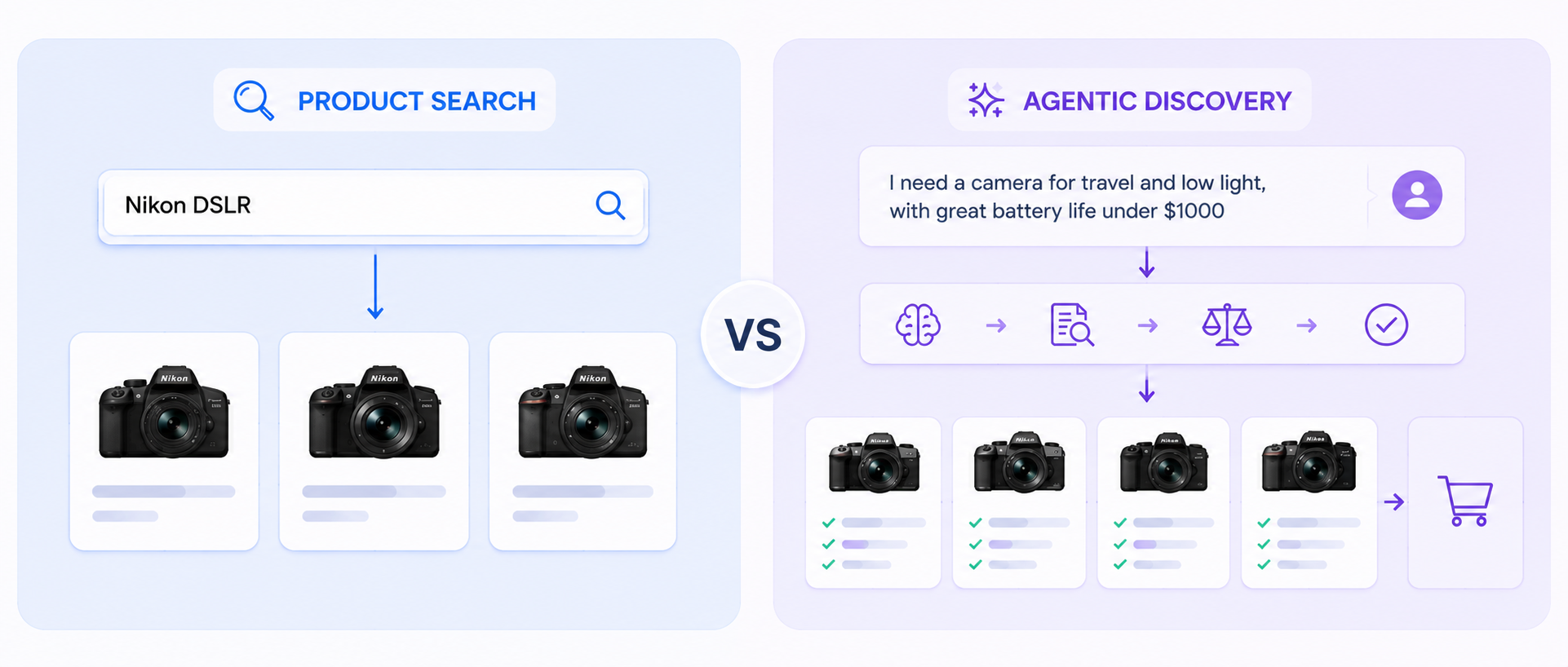
Product Search vs Agentic Discovery
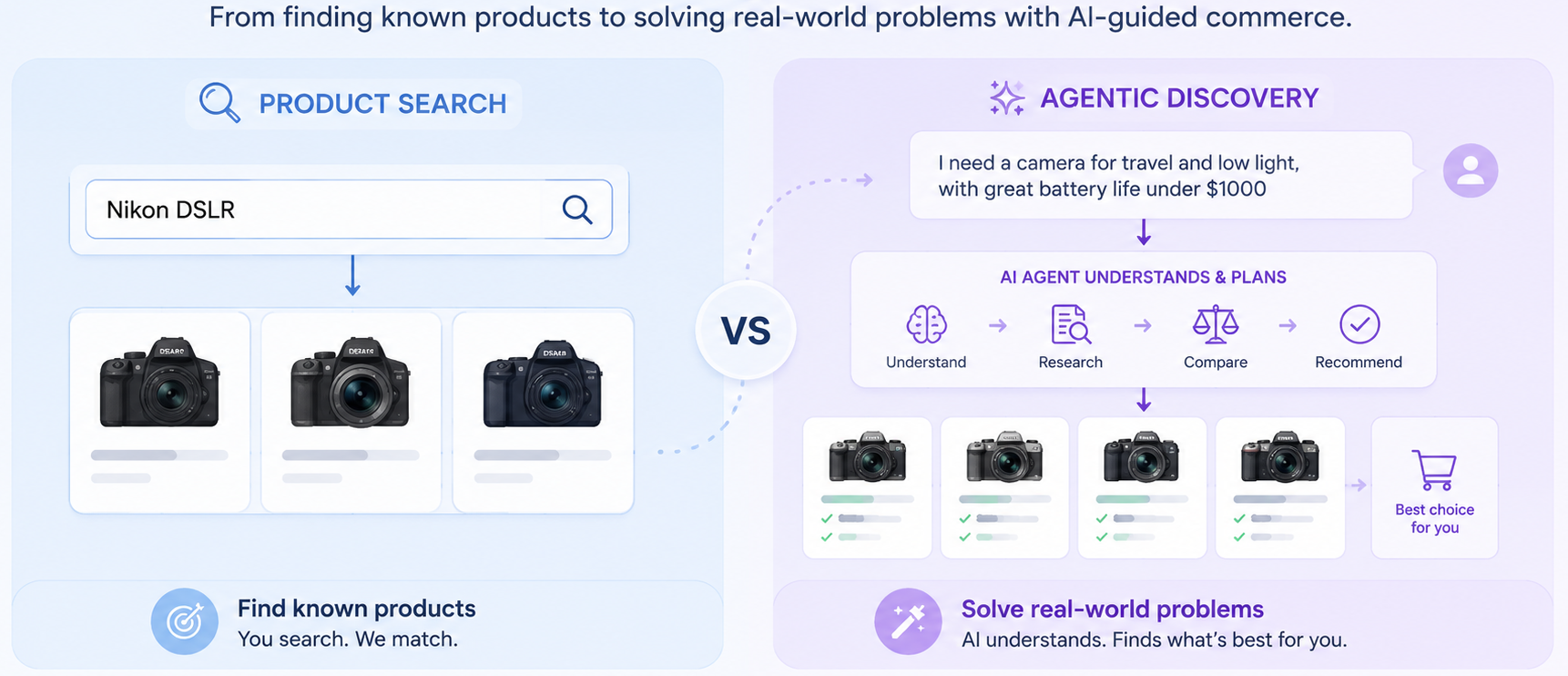
From finding known products to solving real-world problems with AI-guided commerce.

Product search and agentic discovery can look similar from a distance. In both cases, a person may end up on a product page, compare options, and choose where to buy. But the starting point is different, and that difference changes almost everything about how commerce systems need to work.
Traditional product search begins when the shopper already has a product in mind. They know what they want to buy, or at least they know the category well enough to type a useful query. Agentic product discovery begins earlier. The person has a situation, a constraint, a picture, a symptom, or a job to be done. They may not know what product category applies yet.
That gap is where the next generation of product discovery is emerging.
Product search starts with a named thing
Imagine someone is building or upgrading a PC. They already know the CPU they want. Maybe it is an AMD Ryzen 7 7800X3D, an Intel Core i7, or another specific part they read about in a review. At that point, search is mostly about locating the product and deciding where to buy it. The shopper might search the exact CPU name on Amazon, Google, Best Buy, Newegg, or a marketplace. The job of the search system is to answer questions like:
- Which sellers carry this product?
- What is the current price?
- Is it in stock?
- Which listing is the real product and not a confusing variant?
- Can I trust the seller?
- How fast can it arrive?
This is still a hard problem. Product data is messy. Titles are inconsistent. Variants can be confusing. Sponsored results can distort relevance. A catalog may contain duplicates, outdated listings, or products that are technically similar but not interchangeable.
But the shopper's intent is already anchored. They know the thing. The system is helping them find the best place to buy that thing.
In this mode, product search behaves like a highly organized shelf. The user points to a label, and the system tries to return the right items in the right order.
Agentic discovery starts with a problem
Now consider a different kind of shopping journey.
A friend notices a bug at home. They do not know what kind of bug it is. They do not know whether it is harmless, whether it signals a larger problem, or which product category they should search for. Should they look for a spray, a trap, a powder, a cleaner, a sealed container, a professional service, or something else?
Instead of opening a marketplace and typing a product name, they take a photo of the bug and ask AI what to do.
A large language model (LLM) can reason through the situation in a more natural way. It may identify the bug as a likely type, ask where it was found, ask whether there are more of them, and suggest practical next steps. The answer might include non-product actions such as sealing food, reducing moisture, cleaning a specific area, or checking entry points. It might also recommend product types such as bait stations, traps, sprays, mattress covers, storage containers, or protective equipment, depending on the situation.
Only after that reasoning does commerce enter the conversation. The AI might say, "For this kind of problem, you can look for these product types," then suggest specific products and where to buy them.
The buyer did not begin by knowing what to buy. They began by trying to solve a problem. The product recommendation came out of the conversation.
That is agentic discovery.
The intent is not a query, it is a task
The difference matters because product search systems are usually optimized around queries, while agentic discovery is organized around tasks.
In product search, the user says:
Show me this product.In agentic discovery, the user says:
Help me solve this problem.Those two requests require different kinds of product understanding.
For search, a product catalog needs names, brands, categories, prices, images, availability, and enough attributes to distinguish similar items.
For agentic discovery, a product catalog also needs to explain what the product is for. It needs use cases, compatibility rules, risks, constraints, materials, dimensions, instructions, ingredients, certifications, and situations where the product should not be used. The system needs to know not only what the product is, but when it is the right answer.
That is a much richer data problem.
A CPU listing, for example, is not only "AMD Ryzen 7 7800X3D." It is a set of constraints and decisions:
- Which motherboard socket does it require?
- Does it need a discrete GPU?
- What cooler is appropriate?
- Is it a good choice for gaming, rendering, office work, or a budget build?
- What memory and power supply assumptions does it imply?
The same is true for pest control, skincare, home repair, baby products, camping gear, kitchen equipment, and almost every other commerce category. The important information is often not only in the title. It is in the fit between the user's situation and the product's real-world purpose.
Search ranks products, agents assemble solutions
A product search result page usually ranks individual products. The system may personalize the order, blend ads and organic results, filter by price, and let the user narrow the list.
An agentic discovery flow often assembles a solution. That solution might include multiple steps and multiple products, or sometimes no product at all.
For the bug example, a good AI response might include:
- Identify the likely bug from the photo, with uncertainty clearly stated.
- Explain whether the situation looks urgent.
- Recommend immediate non-product actions.
- Suggest the right product categories for the likely bug.
- Exclude unsafe or irrelevant products.
- Compare product options by household context, such as pets, children, room type, and severity.
- Route the shopper to sellers that carry appropriate products.
This is not just search with a chat box on top. The AI is acting more like a product advisor. It translates a real-world problem into a set of possible actions, then connects those actions to products.
That is why agentic discovery can feel so powerful. It matches how people actually think before they know the vocabulary of a product category.
Why this changes the catalog
If commerce starts moving from search boxes to agent conversations, product data has to become easier for agents to reason over.
A human can often scan a product page and infer context from images, reviews, descriptions, and brand familiarity. An agent needs that context represented clearly enough to retrieve, compare, and explain. Thin listings that only say "bug spray, 12 oz" or "gaming CPU" are not enough.
The catalog needs to answer questions like:
- What problem does this product solve?
- What situations is it designed for?
- What should it be used with?
- What should it not be used with?
- What are the important safety, compatibility, or sizing constraints?
- What makes it different from similar products?
- What evidence supports recommending it?
This is where structured product intelligence becomes important. Attributes, taxonomy, embeddings, reviews, instructions, compatibility data, and merchant availability all need to work together. The goal is not only to retrieve a matching listing. The goal is to support a recommendation that can be trusted inside a natural conversation.
The opportunity for merchants
For merchants and marketplaces, product search is still essential. People will continue searching for known products, comparing prices, and choosing where to buy. The CPU buyer still needs a fast, accurate path from product name to available listings.
But agentic discovery opens a larger surface area. It reaches shoppers before they have decided what to buy. It helps when the user only has a photo, a symptom, a need, or an unfinished thought.
That creates a new kind of competition. The winning product may not be the one with the best keyword match. It may be the one whose data makes it easiest for an AI system to understand when, why, and for whom it is the right choice.
In product search, the question is often:
Where can I buy the product I already chose?In agentic discovery, the question becomes:
What should I do, and which products help me do it?Those are different moments in the buying journey. The first is about fulfillment. The second is about guidance.
The future of product discovery will need both.